
NZVC’s second fund targets up to $50m in early-stage investments
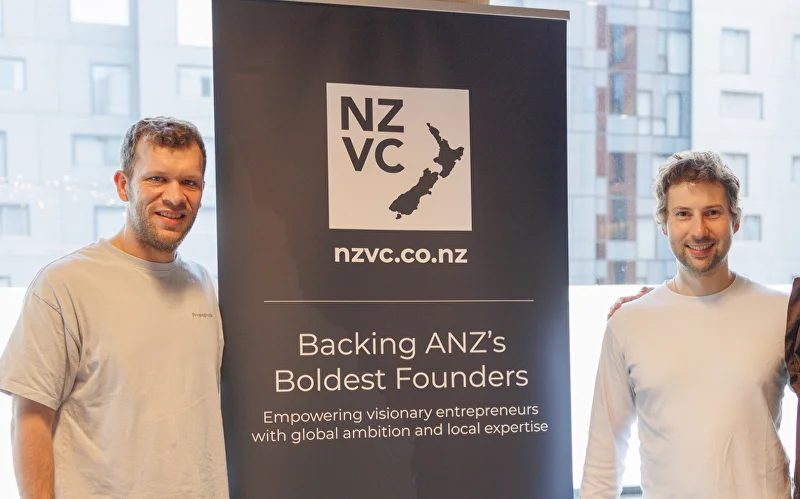
American tech entrepreneur turned New Zealand-based venture capitalist Mark Pavlyukovskyy’s first fund has invested in 53 companies.
Early-stage venture capital firm NZVC has announced the launch of its second fund, and is approaching the half-way point in raising its targeted $50 million.
Established by American entrepreneur and Edmund Hillary fellow Mark Pavlyukovskyy after he found himself locked down in New Zealand during Covid, NZVC’s first fund invested in 53 companies and currently has a multiple on invested capital of 1.5 times.
That means, Pavlyukovskyy claimed, that Fund I ranks among the top 5% of Asia Pacific–based funds for its 2021 vintage.
The plan for the second fund is to back another 50 to 60 founders across New Zealand and Australia with funding from pre-seed to series A rounds, with “smaller initial checks and significant follow-on reserves”.
Fund II’s investments already include on-demand metal casting business Foundry Lab, open banking platform Wych, and Australian pipe-inspection robot company Puralink. Pavlyukovskyy has now been joined as a general partner by Hendrik Remigereau, who was a venture partner on the first fund and is based in Sydney.
Geographically, the fund is targeting 70% of its investment into New Zealand businesses, and 30% into Australia and the rest of the world.
“We’ve had only, I think, four or five that have gone out of business, right? Whereas ... for a lot of
funds in the 2021 vintage, it’d be more like 20% or 30%.
“I don’t know whether that’s a function of New Zealand or a function of the founders we back,
but a lot of them are still in the game ... They’re very capital efficient, and a lot of them have
pivoted several times.”
Fund I portfolio companies include VXT, Kiki, Vessev, Marama Labs, Zenno Astronautics, Bovonic, ArchiPro, Sahha, and Jeuneora.
Its only exit so far is via EasyCrypto, which was acquired by Australian company Swyftx in March this year for an undisclosed sum, although it was said to be a “multi-million-dollar deal” involving a mix of cash and equity.
Pavlyukovskyy told NBR he is “definitely anticipating a few more this year ... at least one more, for sure.”

Easy Crypto is NZVC’s only exit so far in its short life.
Commitment to New Zealand
Since he first arrived here in 2020 as an Edmund Hillary Fellowship participant, just as Covid closed the borders and throttled economic activity around the world, Pavlyukovskyy has committed to staying in New Zealand – not least by starting the fund.
But, as NBR has reported on recently with respect to Hillfarrance Venture Capital, launching a fund in New Zealand is no guarantee that a founder will stick around long term. Hillfarrance took government funding via New Zealand Growth Partners’ Elevate fund.
NZVC has not been a recipient of any Elevate funds so far, Pavlyukovskyy said, adding that he found it confusing that NZGCP was not willing to invest in the first fund, but he hoped it might eventually participate in the second one.
NZGCP basically told him that it wouldn’t invest because the other two of the three partners were overseas-based at that time (the offshore partners were former banker Ajay Gupta and ex-Google Brain leader Glen Anderson).
“They’re doing a very good job, and they manage well with what they had to work with, but ... I don’t know if it’s their conservatism or if it’s the constraints they have from the Government, but ... when we first talked to them, they were like, ‘hey, well, two of your partners are overseas, and so we’re not sure if you’re here to stay for the long term’, basically.”
He felt like his work since then had shown his commitment to this country, and the fund’s success so far had also created some credibility. He has also married and become a father in recent years.
Pavlyukovskyy said he has had good communication with NZGCP and the Government generally. He joined Minister of Immigration Erica Stanford on her recent visit to the United States promoting the Active Investor Plus (AIP) visa.
He said he met about 30 people during the trip and expected that “a few of those will become LPs [limited partners] in our fund”.
He said his story of leaving the US to avoid instability there is continuing to resonate with investors in that country. He has welcomed an existing LP to Auckland this week in preparation for today’s NZVC ‘portfolio day’ – a component of Auckland Startup Week.
“He was basically worried and concerned about the kind of things happening in the US with Trump – the instability, the slight tendencies towards authoritarianism, the lack of clarity, the inability to basically plan his future and his kids’ future. So he was looking for options and alternatives, and we have several LPs who are like that.”
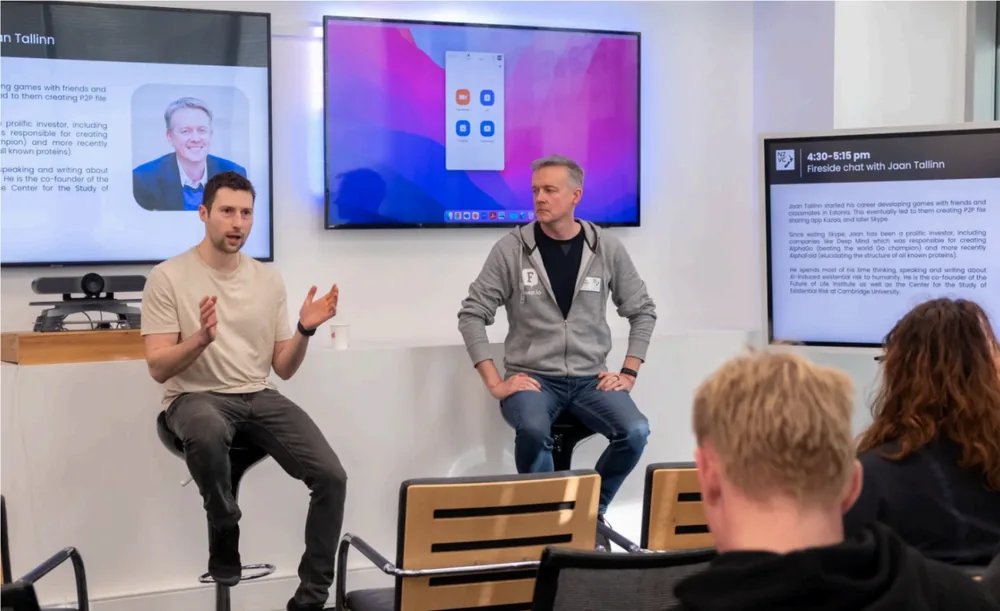
NZVC’s Mark Pavlyukovskyy speaks with Jaan Tallinn at its Portfolio Day in 2022.
More than a VC
The initial idea with having two general partners based in the US was about having insiders on the ground in the country where the wide majority of his LPs were based.
Now, Anderson and Gupta have taken a “step back to become advisers and venture partners to the fund,” he said, partly because of their age and partly because they no longer intend to move to New Zealand.
“I think the Government now is very much more supportive of AIP and funds like us, and I’m very hopeful that NZGCP will become an LP in this fund,” said Pavlyukovskyy.
“I think we’re going to close the $50m without them. We’re pretty much ... by end of the year, we’ll sort of be halfway there; but it’ll be great to have them on board because I think our fund will return a lot of great returns, and those returns, if they’re an LP, will just be returned back to the taxpayer.”
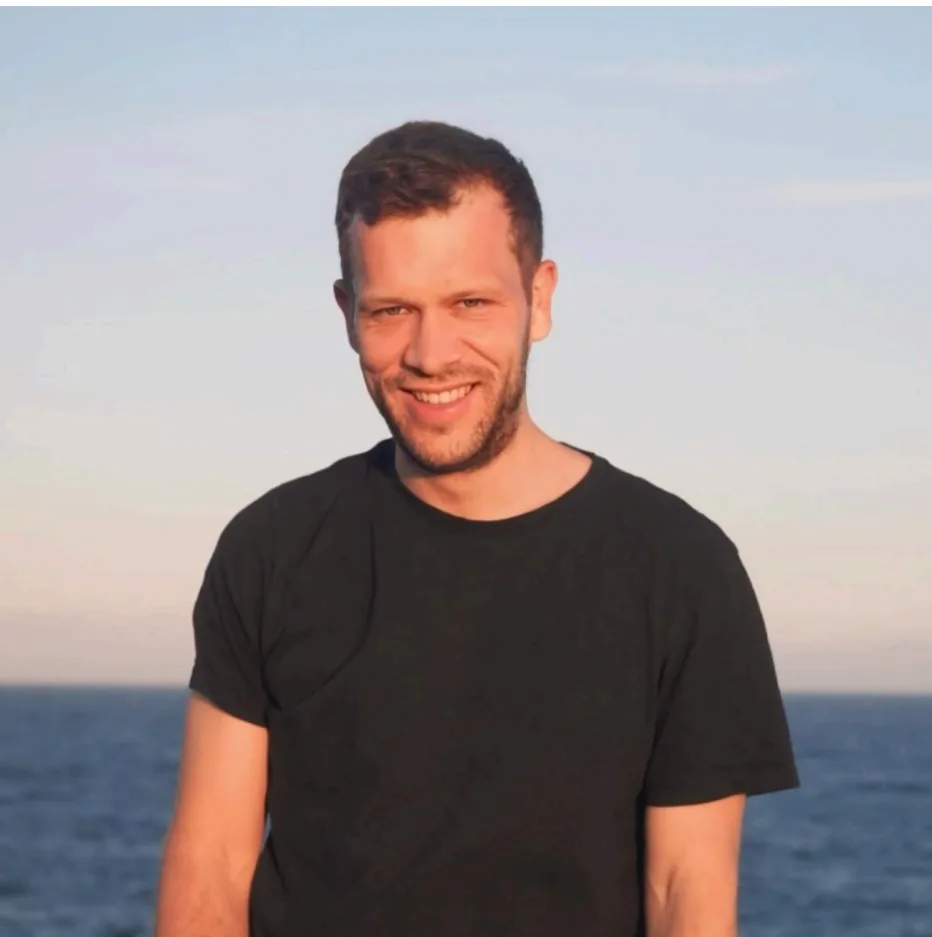
NZVC general partner Hendrik Remigereau
But NZVC still maintains that off-shore presence, with Remigereau having been based in Sydney for two years.
Remigereau believes New Zealand and Australia are like Berlin was when he started out in venture capital around 2015 — smaller ecosystems than the US, but with a few big exits having been done by the likes of Xero and Rocket Lab to show what was possible.
In Berlin, he was a founding director of the Merantix AI Campus — a co-working space for artificial intelligence startups — which has helped more than 100 companies and has more than 2000 members. He also set up the AI House Davos — a not-for-profit think tank that has an annual meeting at the World Economic Forum.
A missing element in both Europe and Australasia was the forging of connections between startups in the local market and investors in North America, he said.
At NZVC, the pair have begun to implement a similar platform approach to connect founders and investors, including through their TechMates podcast, and helping to bring this week’s Auckland Startup Week to life. The pair also jointly own a software development business, called Antipodean Labs, that can assist startups with bringing their ideas to fruition.
Investment strategy
So, what will NZVC’s second fund be investing in? It mentions four strategic areas that it
believes will shape the next decade of innovation and, unsurprisingly, they’re all underpinned by
AI technology.
The first, ‘Service as a software’, is about an AI agent delivering a software-based service where
previously a human might’ve been expected to log on to a software app and do the work.
Then there’s robotics and automation in the physical world; human enhancement in fields such
as longevity, health tech, and cognitive augmentation; and geopolitical sovereignty, which
means tech that aids applications in “reshoring, supply chain, defence, and data-sovereignty”.
Investing successfully in AI requires a nuanced understanding of its capabilities, and demand
for it, said Pavlyukovskyy.
“One thing that I think we’ve both, Hendrik and I, realised as investors is you can be right about the future but, if you’re wrong on the timeline on which it happens, you’ll lose money ...
“It’s AI but, at the end of the day, you still need to understand and value the business based on its core fundamentals of, like, is this actually creating value for somebody? And is that value defensible at the end of the day? Is that something that will be defensible for years and years and decades?”
While there will be resistance to people losing their jobs, if there were no barriers, one could fully automate “probably 50% of the stuff that people do today,” he said.
“It’s like, how fast will this happen? And will it happen faster in certain areas or others? And do you, as a startup, have a specific line of sight to getting penetration because this is such a huge need or such a huge cost centre and people are really incentivised to move fast on this specific area? That’s where a good entrepreneur comes in.”
— Will Mace, Tue, 21 Oct 2025
First published on nzvc.co.nz on 30 October 2025 and kept here as it ran. Fund sizes and portfolio counts were current at the time.
Newer: NZVC will back up to 60 ANZ founders with its new $50 million Fund IIOlder: 2025 looks bright for venture